Class D speed with linear-power weight and control.
A Class D power amplifier built as a complete analog component: fast switching output stage, full-size linear supply, large reservoir capacitance, output filtering, and system matching for effortless loudspeaker drive. Available as a stereo amplifier or as a mono amplifier pair.
This amplifier is built for listeners who want the DAC, level control, and speakers to feel directly connected. The goal is not just rated watts; it is clean grip, stable tone, and a sense that the speaker is being driven without strain.
Class D, done as analog audio
The signal controls switching time, not a file conversion step
In this amplifier, the analog signal arriving from the DAC or preamp is used to control the duty cycle of a high-frequency PWM power stage. The output devices work as fast switches, moving between the supply rails instead of sitting half-on like a conventional linear output transistor. That is why a Class D stage can deliver strong speaker current with far less heat. The audio-band result is recovered at the output filter, where the high-frequency switching waveform is shaped into a loudspeaker-ready signal while reducing switching energy before the speaker terminals.
Energy flow
The supply is part of the sound
Speaker control depends on how quickly energy can move from the power supply to the loudspeaker, and how cleanly the amplifier recovers after a demanding bass note or drum hit. This is why the amplifier uses a full-size linear supply.
Power reserve
Power reserve you can hear as ease
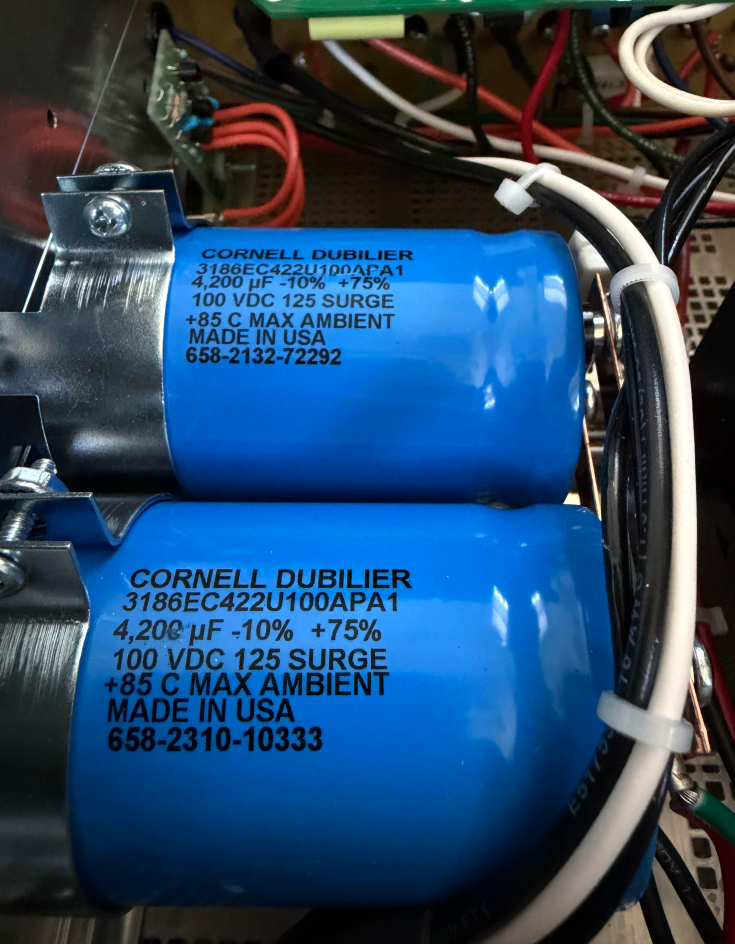
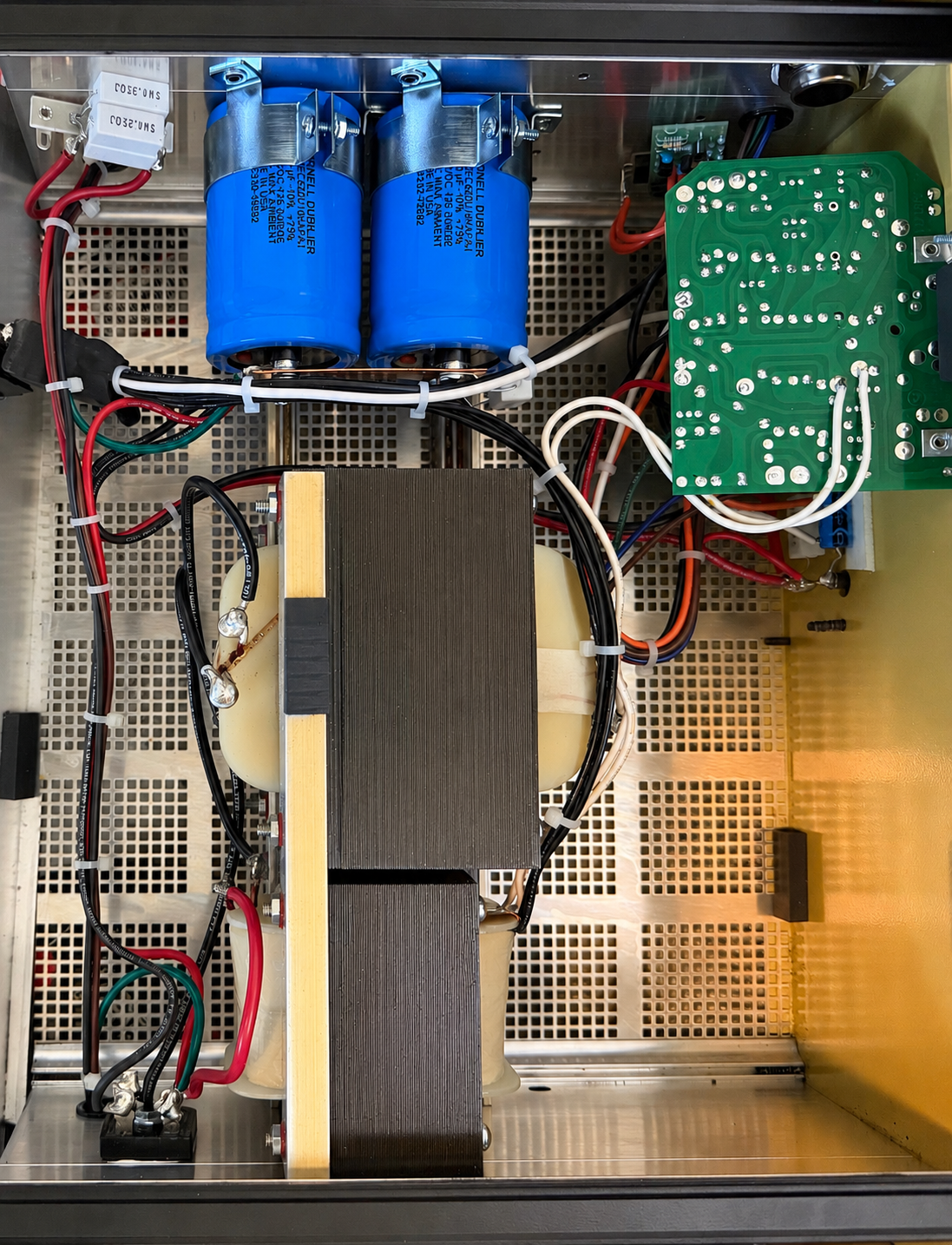
Speakers ask for current in short, demanding bursts. The pictured build uses two Cornell Dubilier 4,200 uF reservoir capacitors, giving the amplifier 8,400 uF of local supply storage near the power stage. That reserve is there to support the main power rail during changing speaker demand; in listening, the result we are aiming for is bass weight, transient ease, and a presentation that does not harden as level rises.
System matching
Configured around the loudspeaker and source
Amplifiers do not live on a test bench. They live with real DACs, real speakers, real rooms, and real volume habits. We offer the amplifier as a stereo build or as mono builds for systems that benefit from a dedicated amplifier per channel. Supply behavior, output filtering, enclosure, connector layout, and thermal approach are set around the system the amplifier is going into.
Features
Key features
Feature
Details
Real speaker control
Drives speakers with grip, quiet backgrounds, and a sense of ease when the music asks for current.
Analog-input Class D
Keeps the post-DAC chain analog while using high-speed switching for efficient loudspeaker drive.
Stereo or mono builds
Choose stereo for a compact two-channel amplifier, or mono builds when the system should dedicate one amplifier to each speaker.
Input level matched to the system
The amplifier is integrated with the DAC, preamp, or attenuator so normal listening happens in a usable control range.
Output filter matched to the amplifier
The filter is part of the amplifier voice, not a leftover engineering detail.
Linear power where it counts
Current reserve, low ripple, and fast recovery give the amplifier stronger control during dynamic passages.
Cornell Dubilier reservoir caps
Adds local supply reserve so the amplifier can respond to speaker current demand without sounding strained.
Built as a component
Enclosure, grounding, cooling, connector layout, and power are chosen as a finished audio product.
Low-heat operation
Class D efficiency helps the amplifier stay composed without the thermal behavior of a traditional hot-running power amp.
Amplifier matching
Our amplifier implementation
Built around a full-size linear supply
This amplifier is built around a linear supply with local reservoir storage close to the amplifier stage. In the pictured build, two Cornell Dubilier 4,200 uF / 100 VDC capacitors provide 8,400 uF of supply storage on the main rail. The engineering purpose is straightforward: keep useful energy close to the stage that drives the speaker. The listening goal is bass weight, transient control, and less strain at higher levels.
Output filtering is voiced as part of the amplifier
The LC output filter, grounding, wiring, and speaker-terminal layout are treated as the final audio stage of the amplifier. The handoff from the switching stage is tuned for clean treble and controlled bass.
The amplifier is built as a power stage
This amplifier is not a source selector or volume-control device. It is intended to sit after the DAC, preamp, or attenuator and focus on the final loudspeaker drive. That keeps the product role clear: accept a line-level analog signal, drive the speaker cleanly, and let upstream components handle source selection and level control.
Gain is matched before the amplifier
The amplifier ships with 32 dB fixed gain. Source level, preamp output, or analog attenuation should be matched before the amplifier so the system has useful volume range and clean peak headroom. As a practical reference, a 20 Vrms speaker-output swing needs about 0.50 Vrms at the amplifier input.
Tech specs
Core specifications
Amplification
8 specs
Spec
Value
System relevance
Amplifier architecture
Analog-input Class D power stage
The amplifier uses high-speed switching for efficient speaker drive while keeping the post-DAC signal path analog.
Amplifier formats
Stereo build or mono build
The amplifier can be configured as a two-channel stereo amplifier or as mono amplifiers for systems that dedicate one chassis per speaker.
Output mode
Stereo speaker outputs or mono speaker output
The output mode is selected around the loudspeaker, room, and system architecture.
Platform class
Up to 200 W stereo into 4 ohm / 425 W mono into 2 ohm platform class
Sharada builds are offered as stereo amplifiers or as mono amplifiers for systems that benefit from one dedicated amplifier per speaker. Final system output depends on speaker load, supply configuration, enclosure, and stereo or mono build.
Amplifier role
Line-level source to loudspeaker drive
The design keeps the analog path short and gives the speakers a controlled power stage.
Topology
PWM Class D with feedback-controlled output behavior
The topology is used for efficient power with stable speaker control and low heat.
Operating character
Efficient speaker drive with a full-size power supply
The amplifier keeps Class D efficiency while using the supply reserve needed for composed speaker control.
Output configuration
Stereo or mono, configured per speaker and room
The output stage, supply behavior, and connector layout are selected around the system rather than a generic module setting.
Power and load capability
8 specs
Spec
Value
System relevance
Power supply approach
Full-size linear supply integration
The amplifier is designed around supply reserve and recovery, not only output-stage efficiency.
Recommended speaker range
Designed for common 3-8 ohm loudspeaker systems
We match the final stereo or mono build to the actual speaker, because real loudspeakers vary with frequency and can dip below their nominal rating.
Load matching
Configured around the intended loudspeaker
Speaker impedance curve, sensitivity, room size, listening level, and stereo-versus-mono architecture all shape the final build.
Stereo output, 1% THD+N
Up to 170 W into 4 ohm
A cleaner high-power reference for stereo systems that want headroom without chasing only the largest wattage number.
Stereo output, 10% THD+N
Up to 200 W into 4 ohm
A peak platform rating that shows available headroom when the amplifier is pushed near its upper limit.
Mono output, 1% THD+N
Up to 325 W into 2 ohm
Mono builds are available when a system benefits from one dedicated amplifier per speaker.
Mono output, 10% THD+N
Up to 425 W into 2 ohm
A peak mono platform rating for systems that need extra current reserve and one amplifier channel dedicated to each loudspeaker.
Efficiency
>90% Class D operation at 4 ohm
High efficiency lets the amplifier deliver useful power without becoming a hot-running component.
Audio performance
9 specs
Spec
Value
System relevance
THD+N at 1 W
<0.02% into 4 ohm
The first watt matters because normal listening spends more time here than near the headline power limit.
Signal-to-noise ratio
>110 dB A-weighted
A low noise floor helps preserve quiet passages, room ambience, and image stability.
Output noise
<100 uV A-weighted
Noise performance matters in quiet rooms and with revealing loudspeakers.
Low-level goal
Quiet first-watt behavior
Most listening happens around the first few watts, where tone, texture, and noise floor matter most.
Dynamic goal
Unstrained recovery after musical peaks
The amplifier is designed so bass hits and large orchestral swings do not make the next moment sound smaller.
Noise behavior
Low-noise layout and supply discipline
Grounding, wiring, and supply design are treated as audible parts of the finished component.
Power-supply rejection
60 dB in BTL, no input signal
The amplifier architecture rejects supply movement, while the Sharada build still treats the supply as part of the sound.
Damping factor
Final measured value pending
Damping factor is measured on the completed amplifier because the supply, output filter, wiring, and speaker terminals all affect the final result.
Output impedance
Final measured value pending
We measure output impedance at the finished amplifier terminals because the LC output filter, wiring, connectors, and stereo/mono configuration all affect the final speaker-control behavior.
System matching
7 specs
Spec
Value
System relevance
Input
Analog line-level input from DAC, preamp, or attenuator
Pairs with high-quality analog output stages without adding extra source handling.
Input format
Single-ended or differential implementation options
Allows the enclosure and connectors to match the rest of the system.
Level matching
Matched with DAC output, preamp or attenuator, and speaker sensitivity
The amplifier platform does not include volume control, so source level and analog level control are treated as part of the system match.
Shipping gain
32 dB fixed gain
The amplifier ships with the gain set; level matching is handled before the amplifier by the DAC, preamp, or attenuator.
Practical input sensitivity
About 0.50 Vrms for a 20 Vrms speaker-output swing
A modest line-level input can already produce high speaker output, so source level and analog attenuation matter.
Speaker load
Configured around the intended loudspeaker
The amp is built around the speaker it has to drive.
Works with
DAC/preamp/attenuator-fed power amplifier role
The source-to-speaker path stays direct, with level control handled before the power amplifier.
Build behavior
5 specs
Spec
Value
System relevance
Output filtering
Class D LC output-filter implementation
The filter is treated as part of speaker control and tonal balance.
Switching behavior
High-frequency PWM switching stage
Useful context for output-filter design, RF behavior, wiring, and enclosure layout.
Power supply
Linear supply integration selected per build
Current reserve and clean recovery are part of why the amp sounds composed.
Thermal behavior
Low-heat Class D operation
Low heat lets the enclosure and layout focus on reliability, damping, and noise control.
Build status
Custom configuration
Enclosure, supply, output mode, connector layout, and speaker matching are chosen for the final system.
Details
Product details
Role
Speaker-drive stage for a DAC-first system.
Configuration
Stereo build or mono build, based on an analog-input Class D platform rated up to 200 W stereo into 4 ohm or 425 W mono into 2 ohm.
System match
DAC plus attenuator systems, preamps, and speakers that like clean efficient drive.
What to listen for
Bass grip, quiet backgrounds, clean transient control, and a sense that the speakers are driven easily rather than pushed hard.
Gain
32 dB fixed shipping configuration.
Input sensitivity
Approximately 0.50 Vrms for a 20 Vrms speaker-output swing.
Configuration note
The finished amplifier is built around the supply, enclosure, cooling, speaker load, and intended use.
Works with
Power-amplifier role for line-level DAC, preamp, and attenuator systems.
Power reserve
The supply reserve behind the easy speaker drive.
Speakers ask for current in short, demanding bursts. This build uses two Cornell Dubilier 4,200 uF / 100 VDC reservoir capacitors for 8,400 uF of local storage on the main power rail. The engineering purpose is to keep useful reserve close to the amplifier stage; the listening goal is firm bass, easier transient behavior, and a more composed sound as listening levels rise.
Linear power + transient recovery
Power for dynamic speaker drive
The amplifier supply is chosen for current delivery, reservoir capacity, low ripple, and stable recovery under changing load. The pictured build uses two Cornell Dubilier 4,200 uF capacitors in the amplifier supply, giving the power stage a visible local reserve behind the easy speaker-drive character we are listening for.