
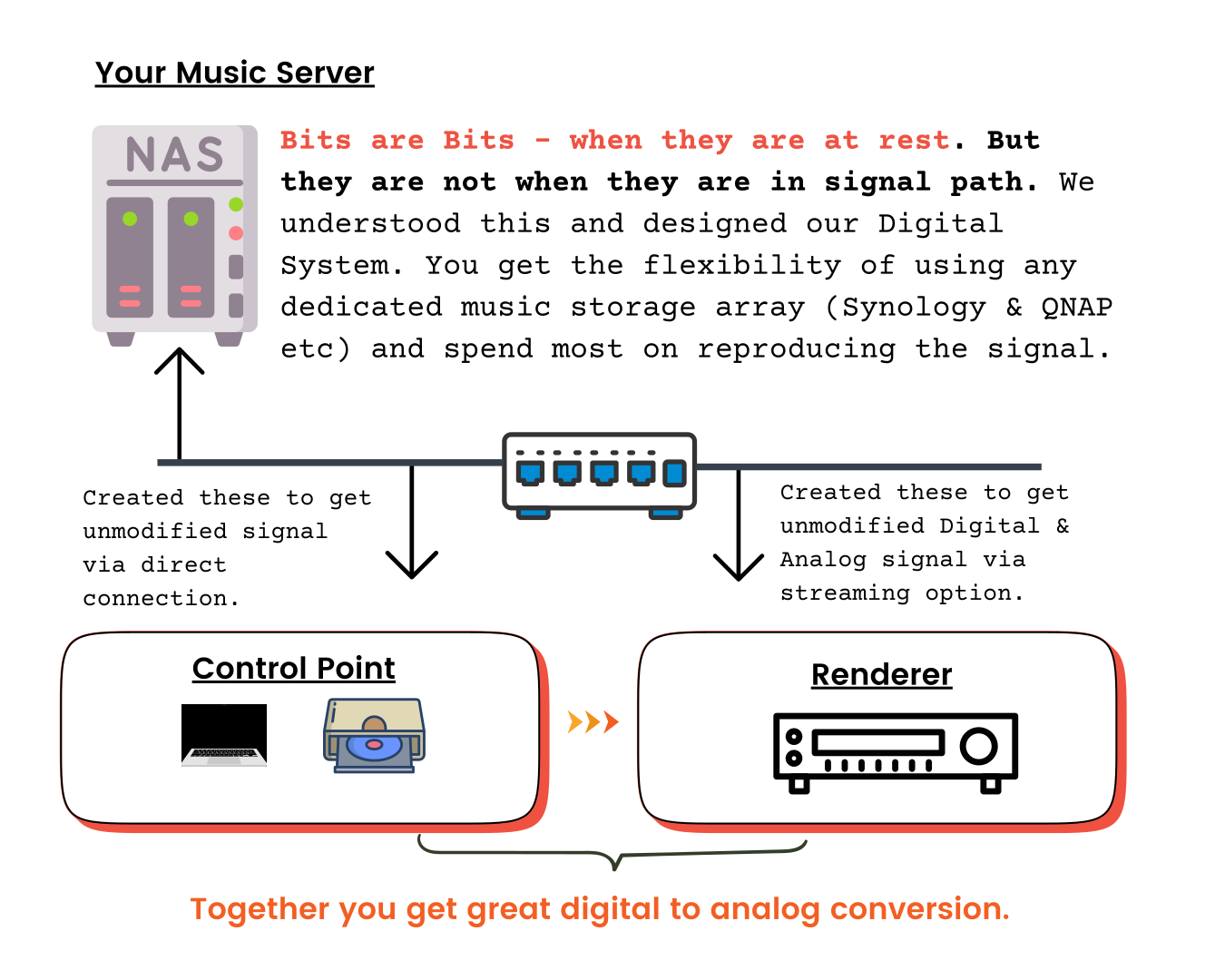
At Sharada Audio, we believe that exceptional audio reproduction begins with understanding and eliminating the fundamental enemies of pristine sound: jitter, electrical noise, and power supply contamination. After years of Computer engineering experience, we have developed what we consider the definitive approach to creating world-class control point and renderer systems that deliver the ultimate front-end for discerning audiophiles.
Digital Audio – Why it is hard?
As a passionate audiophile I have witnessed the audio industry’s ongoing quest for “ultimate” sound. Yet, despite promising claims and ever-increasing feature sets, most traditional CD transports, DACs, and integrated amplifiers with built-in DAC chips fundamentally fail to reach true endgame audio. The reason is simple: commercial “audiophile” devices make profound technical compromises that undermine the pursuit of absolute sonic fidelity.
The cornerstone of any high-performance digital audio component is clean, robust, and isolated power. Commercial designs, regardless of price, typically rely on shared rail power supplies, with multiple digital and analog circuits drawing current from the same source. They often use compact, cost-optimized power supplies, or in some “high-end” cases, basic unregulated linear units, which introduce significant levels of ripple and electrical noise right at the heart of the signal path.
The issue is not just the presence of noise; it’s the insufficient granularity in power delivery—too few independent rails to meet the unique requirements of each stage (clock, analog output, digital processing, etc.). This shortcut, which reduces cost and complexity, directly infects sensitive circuits with noise originating from other parts of the system. Even the best dedicated DACs often cut this corner by sharing power domains, undermining their theoretical performance.
Jitter has become a convenient buzzword because it’s easy to market—“ultra-low jitter clocks” sell gear. But jitter is only one piece of the puzzle. Without addressing power supply purity and ground isolation, chasing lower jitter figures is akin to putting racing tires on a car with a sputtering engine; the improvements are irrelevant compared to what’s fundamentally broken. Real-world testing consistently demonstrates that power supply noise and ground contamination easily eclipse the benefits of even the lowest jitter clocks.
The industry’s obsession with glossy features—DSD playback, upsampling, multi-format digital outputs, streaming, touch panels, CNC-milled aluminum enclosures, and dazzling LED displays—leads to products overloaded with electronics that add more noise, more switching regulators, and more compromise. Each “feature” is a potential pathway for electrical interference to invade the audio signal, and every unnecessary display or control circuit amplifies the risk of contamination.
All too often, this focus on aesthetics and marketing comes at the expense of what truly matters—absolute sonic purity and electromagnetic isolation at every interface and substrate.
Sharada Audio takes a different, engineering-first approach. Instead of investing in features that sell at the showroom, we allocate resources to the fundamentals that define reference-level sound:
- Purposeful Circuit Isolation: Every section of our devices—from protocol bridges to output stages—receives its own power, ground, and electromagnetic shield, slashing cross-domain contamination.
- Feature Restraint: We omit anything not essential to reproduction fidelity. You’ll find no superfluous selectors, fancy displays, flashing LEDs, or casework designed to win beauty contests. Every dollar is spent on what you can actually hear. We apply this principle in building software stack as well.
- Industrial-Grade Components: Instead of high-gloss “audiophile” parts, we specify parts proven in medical, aerospace, and scientific domains for maximum thermal stability, lifespan, and noise rejection.
It is tempting to be lured by the visible—machined aluminum knobs, OLED touchscreens, and arrays of blinking indicators. But achieving true endgame compact disc sound requires relentless attention to what’s under the hood: meticulous component selection, elimination of ground loops, full power domain separation, robust galvanic isolation, and strict avoidance of convenience circuitry that contaminates the signal.
Every additional output or input—be it optical, coax, or network—demands its own power and isolation to avoid seeding noise throughout the unit. Most commercial gear simply cannot afford to provide this level of granularity and, as a result, must fall back on shared resources and wideband digital noise.
CD Quality Sound -Perfected
Our vision eschews the trappings of commercial success—no rainbow-hued chassis, no market-driven feature lists—instead, we focus on delivering CD quality sound reproduced at its maximum potential. We support Airplay in our streamers. Airplay protocol is inherently limited to 44KHz, 16 bits. We worked extremely hard to get the best out of this constraint. It’s about minimizing both jitter and electrical noise to their theoretical limits, exposing the music with all its nuance and emotion intact, free of the artifacts that plague ordinary, even “high-end,” commercial components.
That is why we do not just claim ultimate, we engineer it—where all that matters is what you hear, not what you see.
Jitter Challenge
Digital audio reproduction faces an invisible enemy that can devastate sonic performance: jitter. Jitter represents timing errors in the master clock that controls analog-to-digital and digital-to-analog conversions. When the clock signal drifts, even by billionths of a second, the intervals between samples vary, causing distortion that manifests as noise-like artifacts and FM sidebands in the audio output.
The mathematics are unforgiving. To fully reproduce CD-quality audio with 16-bit resolution and 22 kHz frequency response, jitter must be controlled below 0.25 billionths of a second. This precision requirement is staggering—orders of magnitude beyond what most engineers imagine necessary. Every 500 picoseconds of jitter creates distortion products 96 dB below the signal level, directly impacting the dynamic range that defines high-fidelity reproduction.
In our systems, we achieve ultra-low jitter through carefully engineered clock distribution, galvanic isolation, and precision timing circuits that maintain temporal accuracy across all digital interfaces.
Electrical Noise
Electrical interference represents one of the most pervasive threats to audio quality. Electromagnetic interference (EMI) and radio frequency interference (RFI) can infiltrate audio systems through multiple pathways, degrading signal integrity and introducing unwanted artifacts.
The sources are everywhere: switching power supplies radiating high-frequency noise, household appliances creating electromagnetic fields, and even the circuitry within audio components generating internal interference. This contamination doesn’t merely add audible hum—it can subtly alter soundstage presentation, reduce detail resolution, and compromise the temporal relationships that define musical coherence.
Our approach eliminates these contamination sources through strategic shielding, careful component selection, and isolation techniques that prevent interference from entering the signal path.
DC Ripple: The Foundation of Clean Power
Power supply quality fundamentally determines audio system performance. DC ripple—the residual AC component riding on the DC output—represents a critical specification often overlooked in audio design. Even seemingly small ripple voltages can create audible artifacts, particularly in high-gain circuits.
The ripple factor, calculated as the ratio of RMS ripple voltage to DC voltage, directly impacts circuit operation. While switching power supplies may exhibit ripple levels of 1% or higher, linear power supplies can achieve significantly lower contamination when properly designed.
The Control Point and Renderer Architecture
Our control point design philosophy centers on creating the cleanest possible digital signal path. We begin with ultra-low ripple linear power supplies that provide rock-solid voltage regulation. These supplies eliminate the high-frequency switching noise inherent in conventional power systems, ensuring that sensitive digital circuitry operates in an electrically pristine environment.
The control point incorporates comprehensive galvanic isolation throughout the signal chain. This isolation breaks ground loops, eliminates common-mode noise, and prevents contamination from external sources. Every digital interface—whether USB, AES, or network—receives isolation treatment to maintain signal integrity.
For CD playback, we implement precision transport mechanisms with superior error correction capabilities and clean power delivery. The transport quality significantly impacts the digital data stream, with better transports providing more accurate bit recovery and reduced jitter injection.
Our renderer design focuses exclusively on converting digital audio to analog with maximum fidelity. The system utilizes professional AES digital inputs, which provide superior noise immunity and balanced signal transmission compared to consumer formats.
The renderer operates on carefully optimized Linux-based software that prioritizes audio processing above all other system functions. This approach eliminates the background processes, unnecessary services, and system overhead that plague general-purpose operating systems.
Our renderer (AES Streamer + DAC and USB Transport) employs our own Music Player Daemon (MPD) as the core audio engine. Our MPD offers several critical advantages for high-quality audio reproduction:
Minimal System Overhead: Our MPD runs as a lightweight daemon, consuming minimal CPU and memory resources while maintaining bit-perfect audio output. This efficiency ensures that system resources remain available for audio processing rather than competing with unnecessary background tasks.
Bit-Perfect Playback: MPD prioritizes audio accuracy, attempting bit-perfect reproduction whenever possible. When the audio format matches the output device capabilities, MPD passes the digital stream without modification, preserving the original recording’s integrity.
Advanced Resampling: When format conversion becomes necessary, MPD employs high-quality resampling algorithms that maintain audio fidelity. The system allows configuration of resampling quality to match user preferences and system capabilities.
Network Audio Streaming: Our MPD provides robust support for network audio protocols including AirPlay and DLNA/UPnP, enabling seamless integration with modern streaming sources.
For control point applications requiring Windows compatibility, we utilize Windows Long Term Servicing Channel (LTSC) editions. LTSC provides several advantages for audio applications:
Reduced System Bloat: LTSC eliminates unnecessary applications, services, and background processes that can interfere with real-time audio processing. This streamlined environment reduces potential sources of system noise and timing irregularities.
Stable Platform: LTSC receives security updates without feature changes that might impact audio performance. This stability ensures consistent operation over extended periods.
Extended Support: LTSC versions provide support lifecycles extending years beyond consumer Windows versions, offering long-term platform stability.
Power Supply Engineering
Linear Power Supply Advantages
Our commitment to linear power supply technology stems from fundamental electrical engineering principles. Linear supplies offer several critical advantages for audio applications:
Ultra-Low Noise Floor: Linear power supplies achieve significantly lower noise levels than switching designs, particularly in the audio frequency range. This noise reduction directly translates to improved signal-to-noise ratios and enhanced detail resolution.
Absence of High-Frequency Switching: Unlike switching supplies that generate electromagnetic interference at switching frequencies, linear supplies operate without high-frequency switching, eliminating a major source of system contamination.
Superior Regulation: Well-designed linear supplies provide excellent voltage regulation under varying load conditions, maintaining stable operating voltages for sensitive analog and digital circuits.
Electromagnetic Compatibility: Linear supplies generate minimal electromagnetic radiation, reducing the potential for interference with sensitive audio circuitry.
Isolation and Filtering Strategies
Our power distribution architecture implements multiple isolation stages to prevent contamination between system sections. Galvanic isolation breaks ground loops and prevents noise coupling between different system components.
We employ carefully selected isolation transformers and filtering networks tuned for optimal performance across the audio frequency spectrum. These networks attenuate high-frequency noise while preserving the integrity of audio signals.
Integration and System Synergy
Our modular design philosophy provides audiophiles with unprecedented flexibility in system configuration:
Standalone Control Point: Users can pair our control point with their preferred DAC via USB or AES outputs, integrating our precision digital processing with existing systems.
Standalone Renderer: The renderer accepts digital inputs from any source, providing optimized digital-to-analog conversion and streaming capabilities.
Complete System Integration: When used together, our control point and renderer create a synergistic system where each component’s strengths complement the others.
Interface Optimization
We prioritize AES digital interfaces for their superior technical characteristics. AES connections provide:
Balanced Signal Transmission: AES utilizes balanced differential signaling that rejects common-mode noise and provides superior noise immunity over extended cable runs.
Professional-Grade Specifications: AES interfaces are engineered to professional standards with rigorous timing and amplitude specifications.
High Data Rate Support: AES connections support high-resolution audio formats up to 24-bit/192kHz with excellent signal integrity.
The End Game Philosophy
True audio excellence requires system-level thinking that considers every element in the signal chain. Our approach addresses not just individual components, but the interactions between components, the electromagnetic environment, and the software/hardware interface.
We recognize that achieving the ultimate audio reproduction requires attention to details that may seem insignificant individually but collectively determine system performance. Every power supply filter capacitor, every isolation transformer, every software configuration parameter receives careful consideration and optimization.
Scientific Foundation
Our design decisions rest on solid engineering principles rather than marketing claims or subjective preferences. We measure jitter in picoseconds, quantify noise floors in precise dB specifications, and validate design improvements through objective testing.
This scientific approach ensures that our products deliver measurable improvements in audio reproduction, not merely different sonic signatures that might appeal to particular tastes.
Long-Term Value
By focusing on fundamental engineering excellence rather than trendy features or cosmetic enhancements, our systems provide enduring value that transcends audio fashion cycles. The principles of low jitter, clean power, and minimal system contamination remain constant regardless of changing digital audio formats or streaming protocols.
Conclusion: The Path to Audio Nirvana
Creating the ultimate audio front-end requires unwavering commitment to engineering excellence at every level. From power supply design through software optimization, every decision must serve the single goal of preserving the musical information contained in the original recording.
Our control point and renderer systems represent the culmination of this philosophy—products that eliminate the barriers between the recording and the listener, revealing musical details and emotional content that inferior systems obscure or destroy.
For audiophiles seeking the ultimate front-end solution, the path forward is clear: embrace designs that prioritize engineering substance over marketing superficiality, that measure success in technical specifications rather than subjective impressions, and that recognize audio reproduction as both art and science.
The end game is not a destination but a commitment—a commitment to honoring the musical art through engineering excellence that serves no master except the pursuit of perfect sound reproduction.
At Sharada Audio, we believe that exceptional audio begins with exceptional engineering. Our control point and renderer systems embody decades of scientific research and practical experience, delivering the pristine audio reproduction that discerning audiophiles demand.
Our products are purpose-built audiophile solutions designed for uncompromising sound quality, stability, and versatility in any high-end stereo setup.